We like making it easy for others to play along with us and make their own versions of traditional folk songs. What we don’t like writing each chord over each word and fiddling endlessly with formatting so it displays properly regardless of how someone’s viewing the write-up of a song.
So we use an adapted version of the chord system created by Peter Blood for Rise Up Singing. It’s a little like the notation systems that jazz and country musicians often use — a quick but accurate way of noting a song’s chord progressions(s).
For example, here’s how we’d note “Silent Night”.
 As you can see, there’s a few extra symbols on top of your usual symbols for major, minor, and seventh chords.
| Symbol | Meaning |
| / | A slash divides the chords for one line of lyrics from the next. |
| — | A dash means repeat the previous chord. |
| AE D |
For an example of a ‘squeeze chord’ like this, you would play the A & E chords in the same amount of time you would play the D. This is a proportional way of indicating the rhythm of chord changes. |
| “ | A quotation mark means repeat the chords from the previous line |
| 1st, 2nd, etc. | Play the chords from the 1st, 2nd, etc., line |
Here’s how you would normally write out the chords and words for “Silent Night”.
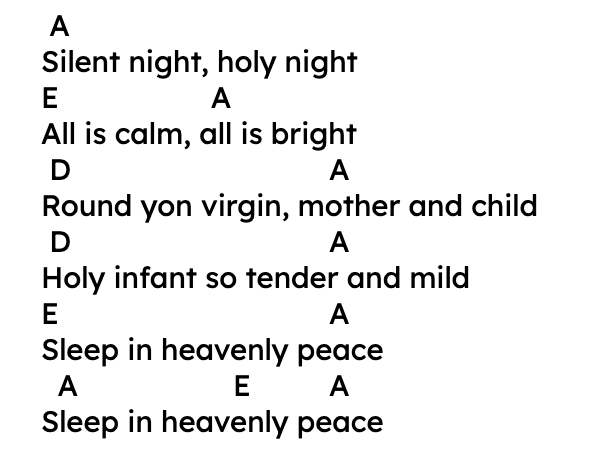 As this example shows, this system allows you to fit lyrics over the chords (not chords to words, like the average chord sheet). This makes for simpler chord sheets and brings you much closer to memorizing a song’s chord progression.
There are a few more chord symbols that we use much less frequently:
| C/B | This means play a C chord with a B as the bass note. |
| C ↓ G | This indicates a bass walkdown from C to G — in this case, hitting B and A
on your way down to the G chord. |
| () | Brackets indicate chords (or 7ths, etc.) that are optional. |
| (in D) | This would indicate that the key of a song is D, even if the first chord isn’t. |
| D(hold) | This would mean strum the D chord once and hold it until you strum the next chord. |
 Blackgrass